Take a sneak peek inside the newest exhibit at the Arms Family Museum.
Included in the exhibit are collections of cameras, postcards, Native American implements, political memorabilia, guns and dolls.
The exhibit is open Tuesday-Sunday from 1:00 to 5:00 p.m. and will be on display through September 2010.
Wednesday, September 16, 2009

Tuesday, September 1, 2009
Uncovering the History of Wick Avenue
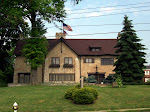
Though it’s no longer recognizable as the house shown in the 19th century photograph below, this structure is still very much part of the historic and cultural fabric of Youngstown’s Wick District. It was built by the widow of a local business leader who died of disease while serving in the Union Army during the Civil War. It was then occupied between 1866 and 1959 by three generations of the same family.
 Emeline Warner Arms was a 35-year-old widow with six children when she began construction of her new home in 1865. Her husband, Myron Israel Arms (uncle of the Historical Society’s benefactor, Olive F. A. Arms), died on September 10, 1864, after contracting Typhoid Fever in his regiment’s camp in Virginia. The family moved into the house the following year, and there Mrs. Arms spent the rest of her days. Her youngest daughter and son-in-law, Harriet A. and Charles H. Booth, remained in the house after Mrs. Arms’ death, and completely remodeled it early in the 20th century, transforming its exterior design from Italianate to an Italian-style villa, as shown below.
 Harriet Arms Booth lived in the house until her death in 1952 at the age of 91. Her daughter and son-in-law, Jane A. B. and Philip H. Schaff, Sr., moved in afterward with their two youngest children. In 1959 the Schaffs sold the house to First Christian Church, located across Spring Street since 1934. The church renamed the building Disciple House, and used it for a variety of functions until 1966, when they sold the property to Youngstown State University. YSU officially changed its name from Disciple House to Alumni House in 1983.
Though the name and function of the property changed over the years, it remains at 606 Wick Avenue as the oldest surviving of the grand houses to be built in this neighborhood in the 19th and early 20th centuries. Join us on Sunday afternoon, September 13, at 1:00 p.m., for free walking tours along Wick Avenue as part of the Founders Day Open House at the Arms Family Museum of Local History. There is diverse historic and modern architecture to see, and many more interesting stories to be told!
Monday, July 27, 2009
Remembering Edna Pincham

Edna D. Pincham, a member of the Mahoning Valley Historical Society’s Board of Directors since 2007 and a passionate community leader, educator and advocate, passed away on June 24, 2009, after a short illness. One of Edna's great passions was local history. She was a key member of the committee which produced the research for an Ohio Historical Marker to honor decorated Civil War veteran Oscar D. Boggess, the first historical marker dedicated to an African American in Mahoning County. The photograph shows Edna on the left at the marker unveiling and dedication in September 2006.
Edna’s published tribute noted that among the proudest events of her life was her inclusion in an exhibit produced by the Mahoning Valley Historical Society in 2001 titled Far From Home: Stories from Immigrant Children to the Mahoning Valley. This exhibit chronicled the migration experience of several young people who left their homes in Europe, the Middle East and the American South to resettle locally in the 20th Century. To honor her memory, following is the text copy that told Edna’s story in the exhibit:
"Edna Pincham grew up in a community full of faith, family and love in southern rural Georgia—the town of Quitman in Brooks County. This rural and religious lifestyle was all Edna knew in her first 18 year of life. Life in Quitman during the 1950s was slower and tight knit, with neighbors around all of the time. There were only three churches in town, and everyone gathered between the three on Sundays. Edna had never left her family before coming to Youngstown. Outside of Florida, she had never been further than Atlanta. She came to Youngstown at the age of 18 in 1954 to attend Youngstown College and live with her sister. Edna’s first experience with racism was when her family took her to a train station for her journey north. There at the station, African Americans were asked to remain in a back room, while white travelers were allowed to sit in a waiting room with plush chairs. The room was small and cramped and they could look through a window at those in the larger room.
Edna took the B&O Railroad from Georgia to Washington DC—a very long trip. She was alone, and had to change trains by herself. Her mom made sure she had enough food until Washington. In a shoe box, she had fried chicken, biscuits, pound cake, and apples and oranges. At that time, African Americans were not allowed in the dining car, so Edna ate the contents inside the shoebox. She even drank the orange juice because she refused to go to the fountain labeled “colored.” On the train from Washington DC, she was able to go to the dining car and water fountain. When she finally arrived in Youngstown, her whole family was waiting to see her, including her sister and brother-in-law. She was excited to see a city with streetcars and was even more thrilled to be picked up in a car. She found a job almost immediately at LaFrance Cleaners and attended school at Youngstown College. Though she continued to face some discrimination at school and in work, she eventually got a job with Dr. W.P. Young who supported her career as a lab technician. Edna went on to have a successful family, co-own a successful moving company, and pursued a career in politics as well. Today Edna is known for her commitment to volunteerism and concern for the welfare of young children in the Mahoning Valley."
Thursday, June 11, 2009
2009 Historic Preservation Award Winners
Community Revitalization Award
Fallen Fire Fighters Bridge (Spring Commons Bridge)
The bridge formerly known as the Spring Common Bridge was refurbished and renamed the Fallen Fire Fighter’s Bridge in 2008. The Bridge was designed by the engineering firm of Wilbur Watson and Associates of Cleveland and constructed in 1949 by the Mt. Vernon Bridge Company. The objective of restoration was to enhance the Bridge while preserving the original design, materials and appearance. The deck was replaced; a new sidewalk was constructed with new railings; and structural steel repairs were made to the beams and girders. The structural steel was cleaned and repainted a shade of red that both commemorates the fire fighters and compliments the surrounding environs.
Commercial Revitalization Award
John R. Davis Building
Youngstown’s late 19th and early 20th century history of development from a small Midwestern town into a thriving metropolis is will documented by the built environment in its downtown. Stemming from concern of the rapid loss of these assets, the three architects of Faniro Architects formed the Sweet Jenny Land Company for the purpose of rescuing and rehabilitating the John R. Davis Building. Built in 1899 the architects saw this building as an opportunity to save an historic structure and to develop it in such a manner as to serve as a model of a mixed-use, adaptive reuse of a historic urban property. The structure houses a street level retail space, the offices of Faniro Architects on the second level and a loft style residence on the upper floor.
MVHS Directors Awards of Achievement
Emerald Street Homes – The Bolan Family
Built between 1900 and 1912 presumably by the steel mills as worker homes, the eight remaining row houses along Emerald Street in Smoky Hollow were acquired by the Bolan Family between 1999 and 2008. Four of the homes are completed and occupied my members of the family, while the remaining four are in various stages of rehabilitation. The renovations have been funded completely by the family who want to protect the environment by resuing and recycling materials, restore the homes on the outside to as near as authentic as possible, use local businesses and vendors, and improve the quality of life in Smoky Hollow.
Friday, May 29, 2009


Tuesday, March 10, 2009
Celebrating Women's History Month - Mary Ann Campana

Mary Ann Campana
Excerpted from The Italians of Youngstown and the Mahoning Valley, Ohio by Joseph Louis Sacchini
Born in Italy, Mary Ann Campana immigrated to Youngstown in 1921. She enrolled in the Youngstown schools attending Oak Street Elementary, Lincoln School and East High School. While working at a five and ten cent store after graduation, she saved part of her earnings for flying lessons and at 18 became Ohio’s first licensed woman teenage pilot. On Sunday, June 4, 1933 Mary Ann set the world’s light airplane endurance record of 12 hours, 27 minutes flying over Youngstown and surrounding communities. She prepared for 5 months and had 44 hours of flight experience. Her aircraft was a Taylor Cub Airplane with a 40 horsepower Continental engine; she had 40 gallons of gasoline and no parachute. Severe electrical storms forced her to land.
Mary Ann Campana was a true pioneer in the field of aviation for women which in the early years was male dominated. In 1993 an Ohio Historical Marker was placed at the Youngstown Warren Regional Airport in honor of her aeronautical and business accomplishments. Ms. Campana resides in Boardman.
Monday, March 2, 2009
Celebrating Women's History Month
 In Search of Polly Potter
This is the story of a search for a woman who was born over 200 years ago; a woman whose early influence helped shape the character of a famous man; a woman who brought culture and an appreciation for learning to a burgeoning Ohio community. It is the story of Polly Potter.
We know what she looked like from her portrait at the Western Reserve Historical Society – beautiful, huge-eyed, intense, with the storybook handspan waist. But because women of the 18th and 19th centuries were identified solely in terms of their relationships to men, they cannot be distinguished from one another by their tastes, their talents, their opinions or their activities outside the home. This makes it difficult to form a clear picture of an individual woman – to bring the hazy feminine silhouette into sharp focus.
Polly, or Mary Potter (Polly being a common nickname for Mary) was born in Wallingford, Connecticut in 1772, the second daughter of Dr. Jared Potter and Sarah Forbes Potter. That same year Dr. Potter had moved his family to Wallingford from New Haven believing that the seaport town was too exposed to withstand the storms of a war he believed to be imminent.
Dr. Potter was something of a character. An early opponent of slavery, his adversaries often charged him with being an infidel and a skeptic. His medical treatment was revolutionary for the time. He was a great believer in diet and regimen in the treating of chronic disease. Potter’s Powder was famous as a gastric remedy, consisting of chalk, ammonium carbonate, camphor and charcoal. This differed widely from the conventional purging and bleeding. His library was one of the most extensive in the state.
He was a speculating theologian in a time when religion was sacrosanct, and his speculations were thought to be of an “infidel character.” It is said that his pupils, although well versed in medical studies, generally left Dr. Potter’s office with “minds tinged with skeptical notions.” In 1803, when a fatal epidemic of dysentery was sweeping the Housatonic Valley, the leading citizens of the town of Huntington sent a messenger to Dr. Potter desiring his assistance, but tactfully suggesting that his heretical opinions not be “scattered about with his prescriptions.”
He had a great love of the natural world, and he purchased a farm of 50 acres about half a mile south of the village center where, along with fruits and flowers, he also cultivated silkworms. Dr. Potter’s character is important in understanding Polly. Lacking a son, it is probable that he imparted at least some of his knowledge, his liberalism and his appreciation of nature to his daughters. Certainly he must have had an enormous influence on them and their opinions and beliefs, and while little is known of Polly’s childhood and formal education, it is almost certain that her mind had been broadened beyond the provincial and that this breadth of outlook was never to leave her.
In 1790 Polly’s sister, Sarah, married Billius Kirtland, a young doctor at Wallingford who had been a pupil of her father’s and it was through this connection that Polly probably made the acquaintance of her future husband, Turhand Kirtland, brother to Bilius. The Kirtlands (or Kyrtlands) were one of the oldest New England families, the first of them having come to Massachusetts in 1635. Turhand was a major stockholder in the Connecticut Land Company, a widower, seventeen years Polly’s senior, a successful businessman, a builder of wagons and stage coaches.
Read More!
Subscribe to:
Posts (Atom)