In the Mahoning Valley Historical Society’s ongoing mission to provide an opportunity for the community to discover local history, the Young Leaders Advisory Board is pleased to announce the next event in the popular History to Go lecture series: Irish in the Valley.
Join the Mahoning Valley Historical Society on Monday, March 10th at 6:30 p.m. at St. Patrick’s Catholic Church, 1410 Oak Hill Ave. in Youngstown, for a presentation on the rich history of the Irish in the Mahoning Valley by Sally Murphy Pallante of The Irish American Archival Society.
This free event is partnered by St. Patrick’s Catholic Church and underwritten by: Rulli Bros.
For further information please phone the MVHS at 330-743-2589 or e-mail at: mvhs@mahoninghistory.org
Monday, March 3, 2008

Thursday, February 21, 2008
You Can Help!
 One of the more frequent requests in the MVHS Archives is for images of national politicians that have made campaign stops in the Valley.
Here's how you can help:
If you attended any of the events hosted by Senators Clinton or Obama, or any other event related to their campaign, and have pictures, please consider donating a set of prints to the archives.
One request:
Prints produced at a photo lab (drug stores, photo shops, and online services) are best for long term preservation. Prints produced on ink-jet or home photo printers are not as stable, and could flake and fade over time.
For more information on donating items to MVHS please don't hesitate to contact the staff!
Please help the Mahoning Valley Historical Society fufill its mission of collecting and preserving your histoy - remember, these are your stories, your experiences, your history!
Image is of Franklin D. Roosevelt making a stop in downtown Youngstown.
Wednesday, February 13, 2008
The First Ice Cream Wagon
Bill Dwyre of the Los Angeles Times provides this story on Kelly Pavlik.
If Youngstown is a "cruddy" place, it is also a place of pride for Pavlik.
"The first ice cream wagon was in Youngstown, Ohio," he says. "You can Google it."
That's exactly right Kelly, the first ice cream wagon was developed by Harry Burt; here is the story!
The Significance of Harry Burt and "Good Humor" Bars
 “Good Humor Suckers” grew to be one of the great icons of American summers of the urban and suburban mid-twentieth century. From the mid-1920s to the mid-1970s, the white refrigerator truck announced by a ringing bell, the white uniformed driver, the pleading with parents for money to buy an ice cream bar, and the gathering of neighborhood children became important, nostalgic memories for several generations of residents of a large area of the United States. Harry Burt, the Youngstown confectionery who strived to make the most delicious candy and ice cream, created the treat, patented the process of production and the machinery for its making, and created the unusual system for its distribution.
History of the Burt Confectionery & Creation of the "Good Humor" Bar
In downtown Youngstown between 1893 and 1922, Harry B. Burt (1875-1926) worked as a confectioner who produced candy, then added ice cream, soda fountain and grill to his store, expanding his business to include a bakery and restaurant, finally adding twelve refrigerator trucks to distribute Good Humor bars to Mahoning Valley and Youngstown city neighborhoods. All these successes he accomplished during the decades of Youngstown’s greatest social, commercial and industrial expansion.
If Youngstown is a "cruddy" place, it is also a place of pride for Pavlik.
"The first ice cream wagon was in Youngstown, Ohio," he says. "You can Google it."
That's exactly right Kelly, the first ice cream wagon was developed by Harry Burt; here is the story!
The Significance of Harry Burt and "Good Humor" Bars
 “Good Humor Suckers” grew to be one of the great icons of American summers of the urban and suburban mid-twentieth century. From the mid-1920s to the mid-1970s, the white refrigerator truck announced by a ringing bell, the white uniformed driver, the pleading with parents for money to buy an ice cream bar, and the gathering of neighborhood children became important, nostalgic memories for several generations of residents of a large area of the United States. Harry Burt, the Youngstown confectionery who strived to make the most delicious candy and ice cream, created the treat, patented the process of production and the machinery for its making, and created the unusual system for its distribution.
History of the Burt Confectionery & Creation of the "Good Humor" Bar

In downtown Youngstown between 1893 and 1922, Harry B. Burt (1875-1926) worked as a confectioner who produced candy, then added ice cream, soda fountain and grill to his store, expanding his business to include a bakery and restaurant, finally adding twelve refrigerator trucks to distribute Good Humor bars to Mahoning Valley and Youngstown city neighborhoods. All these successes he accomplished during the decades of Youngstown’s greatest social, commercial and industrial expansion.
Thursday, January 31, 2008
Award Winning Documentation
Mahoning Valley Historical Society’s Arms Family Museum is documented; Drawings win national award
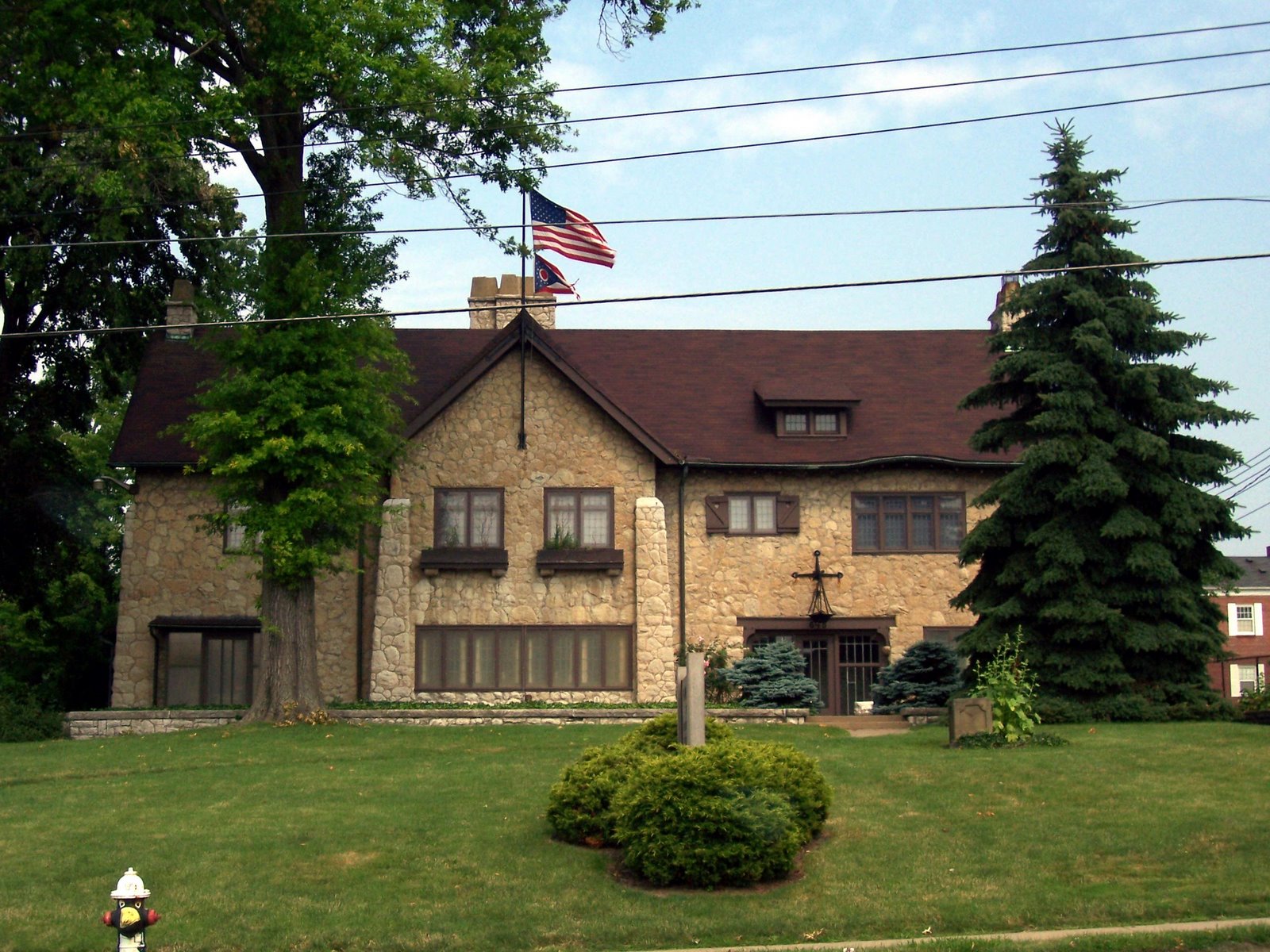
The Mahoning Valley Historical Society is proud to announce that architecture students from Kent State University have won the national Charles E. Peterson prize for their work in documenting the former Olive and Wilford Arms residence, now the Arms Family Museum of Local History, for the National Park Service’s Historic American Buildings Survey (HABS).
The Historic American Buildings Survey (HABS) for Greystone is the first one to be completed in Mahoning County. Funding for the project was provided by The Walter F. and Caroline H. Watson Foundation.
 Students of Elizabeth Corbin Murphy, FAIA, a Principal in the firm of Chambers, Murphy and Burge Restoration Architects, Ltd., of Akron, Ohio, and an Adjunct Professor at Kent State University’s College of Architecture and Environment Design, worked on the Arms House HABS project over the course of the 2006-2007 academic years. They researched original construction documents, sketches and photographs from various eras in the site’s history with assistance from the MVHS staff; they field measured the house inside and out, and measured the property for elevations and major historic landscape features.
 The Students produced measured drawings of the site with plans and elevations of the historic buildings it contains according to United States Department of the Interior, National Park Service’s specifications for HABS submissions; submitted the drawings and other required documents to the National Park Service for acceptance into the HABS collection at the Library of Congress, and provided copies of the same for the MVHS archives collection.
The project was also submitted for The Charles E. Peterson Prize, which annually recognizes the best set of measured drawings prepared to HABS standards and donated to HABS by students. The prize honors Charles E. Peterson, FAIA, founder of the HABS program, and is intended to increase awareness, knowledge, and appreciation of historic buildings throughout the United States while adding to the permanent HABS collection of measured drawings at the Library of Congress. To date, more than 2,000 students from 68 colleges and universities have participated by completing more than 500 entries and almost 5,000 sheets of measured drawings. The Arms House project received first place honors and students accepted the award at a ceremony in New Orleans, LA. They received a $3,000 cash prize. View a slideshow of the 2007 award winners. (The images take a few minutes to load.)
 The Historic American Buildings Survey (HABS), the nation's first federal preservation program, began in 1933 to document America's architectural heritage. According to the Library of Congress American Memory website, “the Historic American Buildings Survey (HABS) and the Historic American Engineering Record (HAER) collections are among the largest and most heavily used in the Prints and Photographs Division of the Library of Congress. The collections document achievements in architecture, engineering, and design in the United States and its territories through a comprehensive range of building types and engineering technologies. All of the documents in the HABS collection are available free of copyright restrictions.
Staff from MVHS attended a presentation at Kent State by Mark Schara, an architect with HABS that outlined the significance of the program, and showed some of the recent projects. The drawings of the Arms house produced by the students were on display as an encouragement for architecture students to apply for the HABS summer programs.
The Mahoning Valley Historical Society is proud to announce that architecture students from Kent State University have won the national Charles E. Peterson prize for their work in documenting the former Olive and Wilford Arms residence, now the Arms Family Museum of Local History, for the National Park Service’s Historic American Buildings Survey (HABS).
The Historic American Buildings Survey (HABS) for Greystone is the first one to be completed in Mahoning County. Funding for the project was provided by The Walter F. and Caroline H. Watson Foundation.
 Students of Elizabeth Corbin Murphy, FAIA, a Principal in the firm of Chambers, Murphy and Burge Restoration Architects, Ltd., of Akron, Ohio, and an Adjunct Professor at Kent State University’s College of Architecture and Environment Design, worked on the Arms House HABS project over the course of the 2006-2007 academic years. They researched original construction documents, sketches and photographs from various eras in the site’s history with assistance from the MVHS staff; they field measured the house inside and out, and measured the property for elevations and major historic landscape features.
 The Students produced measured drawings of the site with plans and elevations of the historic buildings it contains according to United States Department of the Interior, National Park Service’s specifications for HABS submissions; submitted the drawings and other required documents to the National Park Service for acceptance into the HABS collection at the Library of Congress, and provided copies of the same for the MVHS archives collection.
The project was also submitted for The Charles E. Peterson Prize, which annually recognizes the best set of measured drawings prepared to HABS standards and donated to HABS by students. The prize honors Charles E. Peterson, FAIA, founder of the HABS program, and is intended to increase awareness, knowledge, and appreciation of historic buildings throughout the United States while adding to the permanent HABS collection of measured drawings at the Library of Congress. To date, more than 2,000 students from 68 colleges and universities have participated by completing more than 500 entries and almost 5,000 sheets of measured drawings. The Arms House project received first place honors and students accepted the award at a ceremony in New Orleans, LA. They received a $3,000 cash prize. View a slideshow of the 2007 award winners. (The images take a few minutes to load.)
 The Historic American Buildings Survey (HABS), the nation's first federal preservation program, began in 1933 to document America's architectural heritage. According to the Library of Congress American Memory website, “the Historic American Buildings Survey (HABS) and the Historic American Engineering Record (HAER) collections are among the largest and most heavily used in the Prints and Photographs Division of the Library of Congress. The collections document achievements in architecture, engineering, and design in the United States and its territories through a comprehensive range of building types and engineering technologies. All of the documents in the HABS collection are available free of copyright restrictions.
Staff from MVHS attended a presentation at Kent State by Mark Schara, an architect with HABS that outlined the significance of the program, and showed some of the recent projects. The drawings of the Arms house produced by the students were on display as an encouragement for architecture students to apply for the HABS summer programs.

MVHS Executive Director Bill Lawson (far right) congratulates the Kent State students on a job well done. With Mark Schara (far left) and Elizabeth Corbin Murphy (second from left).
Read the Youngstown Vindicator article here.
Thursday, January 17, 2008
William Rayen
The Mahoning Valley Historical Society has a vast collection of priceless objects. Most of which are stored in non-public areas of the Arms Family Museum. Greystone, as it was named by Olive Arms, was built in 1905 and while it has held up beautifully over the past 100 years, the age of the house offers some challenges to maintaining proper environmental conditions for the collection. In February of 2007, extremley frigid temperatures caused condensation to form in some collections storage areas. Unfortuantley, a few portraits and paintings were in harms way, and suffered some water damage.
Luckily, the Mahoning Valley Historical Society is a member of the Intermuseum Conservation Association located in Cleveland. This is a fantastic facility with world class conservators. Several pieces were taken to ICA for evaluation and restoration.
One of the pieces was a portrait of William Rayen from the early 1800's. Water ran down the back side of the canvas and caused the varnish to blanch, seen in the first picture.
 The paintings conservator removed the painting from the frame, and removed the blanched varnish with an isopropanol alcohol. By examining the paint layers under magnification and in ultraviolet light, the conservator also determined that there was previous retouching done to the black paint of the coat and to the face.

The portrait in progress:
+small.jpg)
In order to understand the significance of the portrait to the MVHS collection, one must realize the contributions Rayen made in the early history of Youngstown.
William Rayen
William Rayen was born in 1776 in Kent County, Maryland. He and his wife Margaret Caree Rayen operated a mercantile in Westmoreland County, Pennsylvania from approximately 1796-1799, before settling in the Mahoning Valley before 1802. Rayen also operated a tavern and mercantile in Youngstown, during that time, he became involved in politics and other local businesses. He served as postmaster from 1818 to 1839, keeping the post office in the store. He was township clerk in 1816, justice of the peace after 1819, and associate judge of the court of common pleas after 1820. He was a stockbroker and director of the Pennsylvania and Ohio Canal Company. In 1819 he helped form an agricultural society and became its secretary. He cultivated his own land and orchards during most of his life. William and Margaret had two children, both of whom died before reaching adulthood. Margaret Rayen died in 1826, William in 1854.
 William Rayen's Store
William Rayen opened the first public house in Youngstown, Rayen's Tavern, in 1802. Ten years later, he opened a store at the corner of Federal and Holmes (present-day Fifth Avenue), and did business there for twenty-five years, most of the time in partnership with James Mackey. "Rayen and Mackey" closed in 1837.
This image is a page from one of Rayen's daybooks.
Youngstown’s First High School
When William Rayen died in 1854, his will set aside $31,390 for a public academy to be known as “The Rayen School.” P. Ross Berry, an African American brick and stone mason, built the four-room brick building at the corner of Wick and Wood in the Greek Revival style of architecture. It opened its doors in 1866 with forty students and a predominantly female faculty. It graduated Youngstown’s first high school students several years later. The Rayen School was the city’s only high school until 1911. This image is the original building ca. 1870.
Luckily, the Mahoning Valley Historical Society is a member of the Intermuseum Conservation Association located in Cleveland. This is a fantastic facility with world class conservators. Several pieces were taken to ICA for evaluation and restoration.
One of the pieces was a portrait of William Rayen from the early 1800's. Water ran down the back side of the canvas and caused the varnish to blanch, seen in the first picture.
 The paintings conservator removed the painting from the frame, and removed the blanched varnish with an isopropanol alcohol. By examining the paint layers under magnification and in ultraviolet light, the conservator also determined that there was previous retouching done to the black paint of the coat and to the face.
The portrait in progress:
+small.jpg)
After all the varnish was removed, some retouches were made and the portrait was given a protective spray, felting to protect the canvas edges, and new hardware for hanging.
In order to understand the significance of the portrait to the MVHS collection, one must realize the contributions Rayen made in the early history of Youngstown.
William Rayen
William Rayen was born in 1776 in Kent County, Maryland. He and his wife Margaret Caree Rayen operated a mercantile in Westmoreland County, Pennsylvania from approximately 1796-1799, before settling in the Mahoning Valley before 1802. Rayen also operated a tavern and mercantile in Youngstown, during that time, he became involved in politics and other local businesses. He served as postmaster from 1818 to 1839, keeping the post office in the store. He was township clerk in 1816, justice of the peace after 1819, and associate judge of the court of common pleas after 1820. He was a stockbroker and director of the Pennsylvania and Ohio Canal Company. In 1819 he helped form an agricultural society and became its secretary. He cultivated his own land and orchards during most of his life. William and Margaret had two children, both of whom died before reaching adulthood. Margaret Rayen died in 1826, William in 1854.
 William Rayen's Store
William Rayen opened the first public house in Youngstown, Rayen's Tavern, in 1802. Ten years later, he opened a store at the corner of Federal and Holmes (present-day Fifth Avenue), and did business there for twenty-five years, most of the time in partnership with James Mackey. "Rayen and Mackey" closed in 1837.
This image is a page from one of Rayen's daybooks.
Youngstown’s First High School

When William Rayen died in 1854, his will set aside $31,390 for a public academy to be known as “The Rayen School.” P. Ross Berry, an African American brick and stone mason, built the four-room brick building at the corner of Wick and Wood in the Greek Revival style of architecture. It opened its doors in 1866 with forty students and a predominantly female faculty. It graduated Youngstown’s first high school students several years later. The Rayen School was the city’s only high school until 1911. This image is the original building ca. 1870.
Thursday, December 27, 2007
The Arms Family History

The Mahoning Valley Historical Society is compiling genealogical information on the Arms Family of the Mahoning Valley to better understand the family, their connections to the valley, their impact on the region, and to interpret their home accurately.
Upon her death in 1960, Olive F. A. Arms (pictured) left to the Mahoning Valley Historical Society her home and its contents at 648 Wick Avenue, Youngstown, Ohio with the stipulation that the estate be developed as the Arms Museum, referring to her parents Charles Dayton Arms and his wife Hannah Maria, nee: Wick.
Olive Freeman Arms married a cousin, Wilford Paddock Arms. This unknown relationship between Olive and Wilford began our search for their roots, in an effort to understand them, their families, and to determine exactly how closely they were related. Our research uncovered the fact that Olive’s great grandfather Daniel Arms was also Wilford’s grandfather, making the pair half first cousins once removed, legally and genetically distant cousins. Daniel Arms had married twice. Olive is descended through Daniel and his first wife Luany through their son Israel. Wilford is descended through Daniel and his second wife Nancy through their son Lawson, Wilford’s father.
The Arms family originated in the New England states, most notably near Deerfield, MA. Daniel and his family moved to the frontier of western New York near Sodus, Wayne County, New York, being among that area’s first pioneer families. Israel’s widow Sarah and their children made the move to the Mahoning Valley where they rapidly became involved in commerce, industrial pursuits, and community life. The Arms family is connected to the Wick, Baldwin, Booth, and Bonnell families, to name a few. Wick Avenue bears its name because of Hannah Maria Wick, wife of Charles Dayton Arms, her father Caleb Baldwin Wick, and members of the Wick Family owning property in this vicinity.
MVHS has created a PDF file of the Genealogy of the Arms and Related Families. This Adobe readable file is available in the archival library. In addition to genealogical information, the file also contains tidbits and background for many of the Valley’s “movers and shakers.” The genealogical report is indexed and accompanied by pedigree charts for a number of the primarily lineages, appearing as an appendix to the main document.
Recently Richard Clarke of Connecticut contacted us asking if the Arms Family Museum had any connection to the Arms of Conway, Franklin County, Massachusetts. Mr. Clarke has been involved in compiling information about New Milford, CT families, many of which also have connections to the Mahoning Valley: Canfield, Boardman, Baldwin, Mygatt, Hine, Treat, Bostwick. Our answer was a resounding yes. The Arms family is connected to Conway through Daniel’s son Israel, born there prior to moving to New York. Mr. Clarke has provided copies of his research to MVHS, available for research at our archival library. Copies of his research are also available for purchase through Mr. Clarke.
Contact information may be obtained from MVHS at 330-743-2589 or via e-mail at archives@mahoninghistory.org.
Wednesday, December 12, 2007
Let's Go Shopping!
Shop Greystone Gifts at the Arms Family Museum this holiday season!
These hand painted ornaments are only $9.00 each!

There is a great selection of nostalgic toys!

Radio inspired gifts include old-time radio shows and Christmas shows on CD.

Fascinating books are great for history buffs!

These authentic hand-made Arts & Crafts tiles are stunning!
These ornaments are just $8.00 and they include the stand!

These hand painted ornaments are only $9.00 each!

There is a great selection of nostalgic toys!

Radio inspired gifts include old-time radio shows and Christmas shows on CD.

Fascinating books are great for history buffs!

These authentic hand-made Arts & Crafts tiles are stunning!

These ornaments are just $8.00 and they include the stand!

Greystone Gifts is located in the Arms Family Museum of Local History and is open Tuesday-Sunday from 1-5pm.
Most items can be shipped - please call for details!
(330) 743-2589
Subscribe to:
Posts (Atom)